ELISpot Plus: Human IP‑10 (HRP)

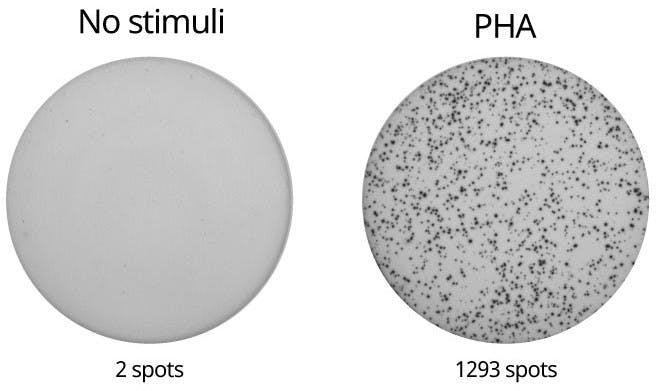
PBMC (20,000 cells/well) were incubated for 20 h in the absence or presence of PHA and the number of cells secreting IP-10 (CXCL10) was analyzed by ELISpot.

ELISpot Plus: Human IP‑10 (HRP)

3401-4HPW-2

Publications: 0
Documents
Bulk or custom format
The easiest way to achieve reproducibility in ELISpot.

Components

PlatePre-coated ELISpot plate, white MSIP (mAb MTP11)
Detection mAbMTP13, biotin
Enzyme conjugateStreptavidin-HRP enzyme conjugate
SubstrateTMB substrate for ELISpot

In stock

Delivery 4-9 business days

Shipping $0

Intended use

This ELISpot Plus kit is intended for the enumeration of cells secreting human IP-10 using the ELISpot assay. For research use only. Not for use in diagnostic procedures.

Serum/Plasma samples

Recommendation

Product details

ProductELISpot Plus: Human IP-10 (HRP)
ApplicationELISpot
AnalyteIP-10 (CXCL10)
ReactivityHuman, Non-human primates
Specificity

This kit is based on a matched pair of mAbs specific for human IP-10. 

Cross-reactivity

The mAbs cross-react with IP-10 from non-human primates (NHP).

Shipping and Storage

Shipping

Shipped at ambient temperature.

Storage

Store antibodies, enzyme conjugate, and substrate at 4-8 °C upon receipt. Plates may be kept at room temperature. 

Shelf lifeAt least 18 months from date of receipt.

PBMC (20,000 cells/well) were incubated for 20 h in the absence or presence of PHA and the number of cells secreting IP-10 (CXCL10) was analyzed by ELISpot.

Tutorial

Cell stimulation in ELISpot and FluoroSpot

In this feature, we’ll walk you through the optimal use of different polyclonal and antigen-specific stimuli.

Loading publications...

IP-10 (CXCL10)

Analyte description

Interferon gamma-induced protein 10 (IP-10) secretion is induced by IFN-γ, TNF-α, and IL-1β. This proinflammatory cytokine is produced by monocytes, endothelial cells, and fibroblasts. The interferon gamma-induced protein 10 recruits lymphocytes to sites of infection and increases the expression of MHC class I molecules. In addition to chemotaxis, IP-10 is also involved in the differentiation and activation of peripheral immune cells, regulation of cell growth, apoptosis, and modulation of angiostatic effects. The binding of IP-10 (CXCL10) to the CXCR3 receptor causes the downstream activation of the phospholipase C-dependent pathway, an increase in intracellular calcium production, and actin reorganization. 

Alternative namesInterferon gamma-induced protein 10, IP-10, C-X-C motif chemokine ligand 10, CXCL10, small-inducible cytokine B10
Cell typeT cell, Monocyte/MΦ
Gene ID3627