
Sharp detection of viral foci
Sharp detection of viral foci FociSpot is an innovative assay kit designed to precisely detect and quantify focus-forming units (FFUs). The assay is easily adaptable for measuring neutralizing antibody titers, quantifying virus titers in samples, or 50% Tissue Culture Infectious Dose (TCID50) – an essential tool for virology research, combining the precision and reliability of focus-forming assays with optimized protocols and reading.
Customizable to fit your needs
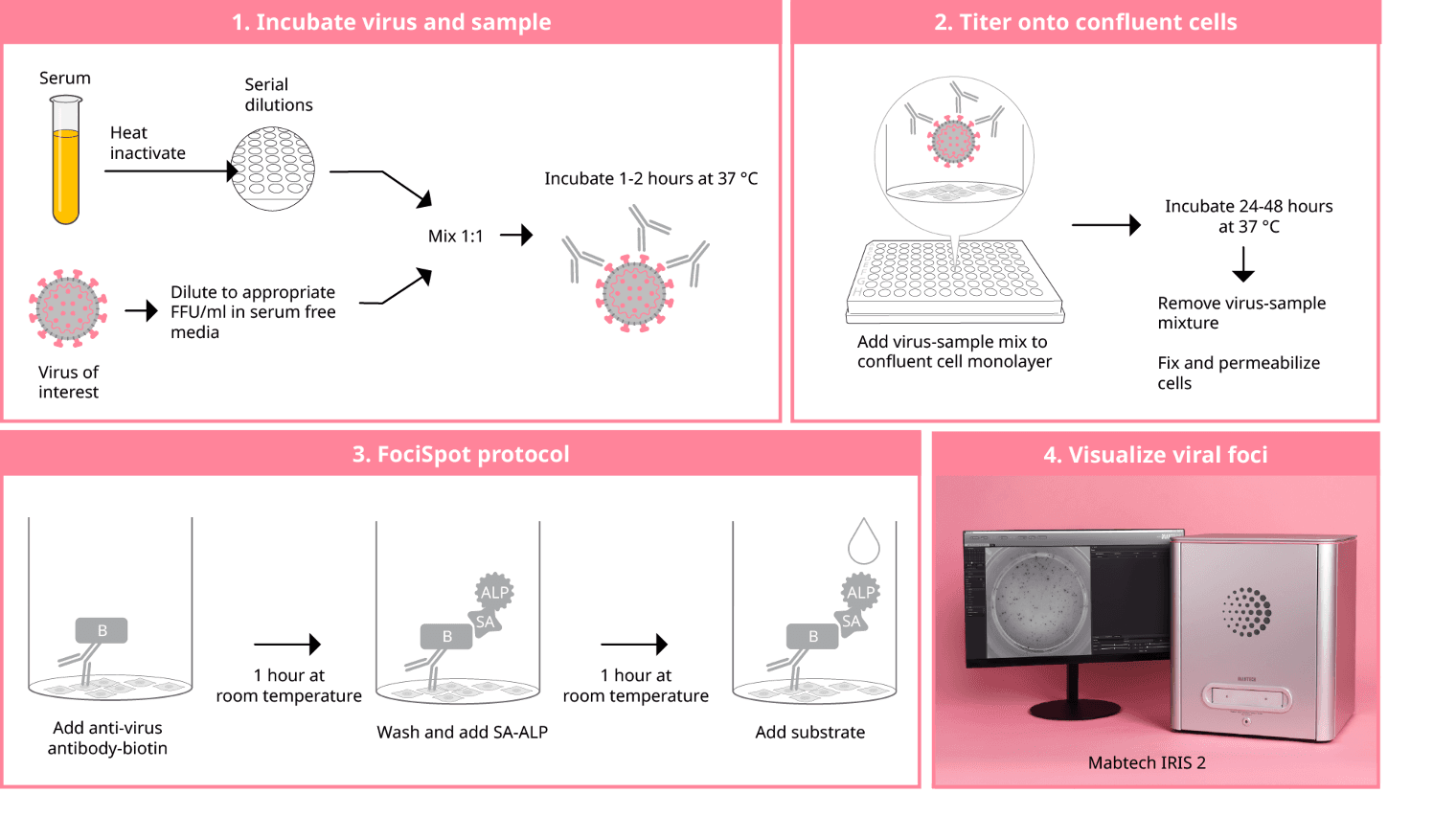
We know each viral assay is unique, but we’ve streamlined the detection and reading steps. If we take a typical focus reduction neutralization test (FRNT) for example, dilutions of a serum sample containing potential neutralizing antibodies (nAbs) is mixed with a known titer of virus. This mixture is then added to a monolayer of cells in a 96-well plate and incubated overnight.
The following day, the virus-sample mixture is removed and this is where the FociSpot kit protocol comes into play. Following fixation, a virus-specific biotinylated mAb is added to detect viral proteins in the cells. Then a steptavidin-ALP conjugate is added just like in ELISpot so that when substrate is added, foci are visualized and can be counted in IRIS 2.

Confidence in every well
Your samples are precious and your results must be trusted. That’s why we pair proven assay technology with direct access to experienced support scientists. If something doesn’t go as planned, we’ll work with you to get it right. Because our goal isn’t just an assay that runs, it’s an assay that delivers trustworthy results, every single time.


FociSpot applications and usage
FociSpot is our umbrella name for Focus-Forming Assay (FFA) kits. FFAs can be used in a number of ways for your virus research.
Virus quantification: FFA techniques like TCID50 are used to determine the amount of infectious virus in a sample. This is vital for understanding viral load and its impact on disease severity or transmission.
Antiviral drug testing: FFAs are instrumental in testing the effectiveness of antiviral drugs. They allow researchers to determine the concentration of a drug needed to inhibit viral replication, providing crucial data for drug development and approval.
Vaccine efficacy: FRNT is commonly used to assess the neutralizing capacity of antibodies generated by vaccines as well as nAb titers. By measuring how well these antibodies can prevent virus infection in cell cultures, researchers can evaluate and compare the efficacy of different vaccine candidates.
Viral pathogenesis: These assays help in understanding how different viral strains or mutations affect infectivity and virulence. By comparing the infectivity rates of different viral variants, researchers can gain insights into the mechanisms of viral pathogenesis.

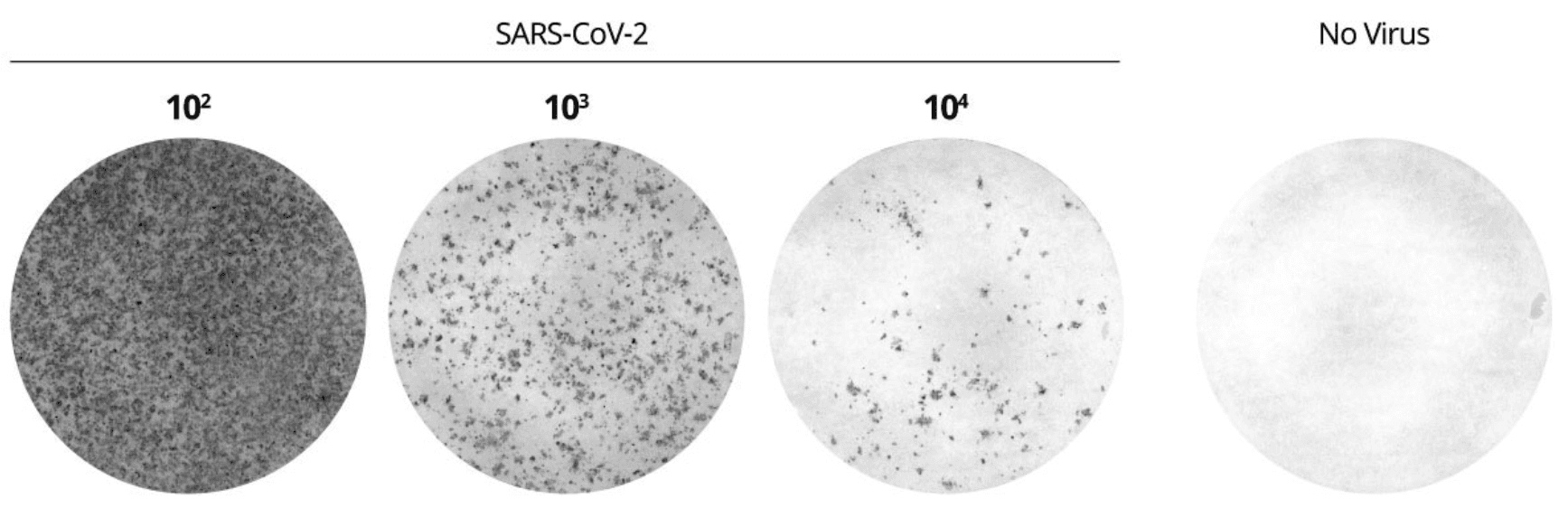
Increasing dilutions of SARS-CoV-2 added to cells and detected with FociSpot
Automated foci counting
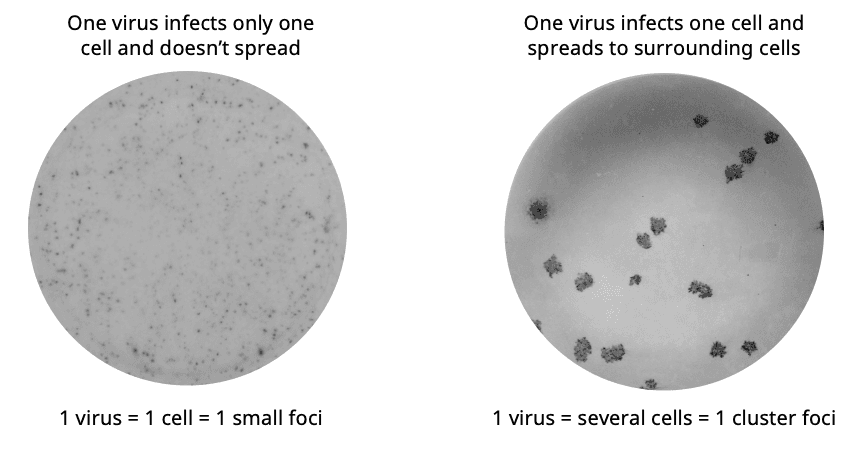
In the Apex software of IRIS 2, you'll find FociSpot as an assay format, in addition to ELISpot and FluoroSpot. Simply choose FociSpot and the plate format, insert your plate, and press read. IRIS 2 quickly captures images of each selected well and desired count settings can be applied to enumerate foci. The RAWSpot™ algorithm is used to enumerate smaller, spot-like foci, while the cluster algorithm is used for cluster-like foci. These options give you the flexibility to read your specific viral assay to provide you with the best results possible.
Counting foci has never been easier and, most importantly, more accurate.

Want to explore more?