
For ELISpot
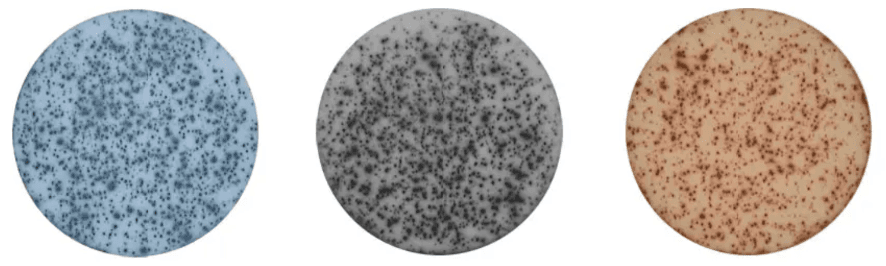
In ELISpot, the substrate must form an insoluble precipitate – meaning it settles at the bottom of the well after being catalyzed by the enzyme. This precipitate is what creates the visible “spot”.
Several precipitating substrates are available, but we recommend BCIP/NBT-plus for ALP conjugates and TMB for HRP conjugates. Both offer high sensitivity and produce sharp, well-defined spots that are easy to evaluate.
Development time depends on multiple factors, including the analyte, detection antibody, enzyme conjugate, substrate, and the amount of analyte secreted. When using reagents not supplied by us, you may need to titrate the detection antibody and streptavidin–enzyme conjugate to identify optimal concentrations. If you’re using our reagents, simply follow the kit protocol 😊.
How you stop the reaction depends on whether you’re using BCIP/NBT-plus or TMB (see Recommendations below).

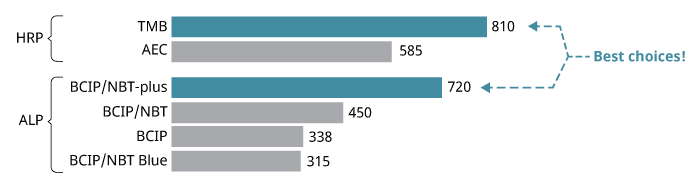
Spot counts for different enzyme-substrate combinations.

Recommendations
| Enzyme+substrate | Development time | To stop, wash with |
| ALP+BCIP/NBT-plus | 3-15 min | Tap water |
| HRP+TMB | 2-10 min | Deionized water |
Tip! Deinonized water is always ok for stopping the reaction, but vital for HRP+TMB as ions and altered pH may cause TMB spots to fade.
For ELISA
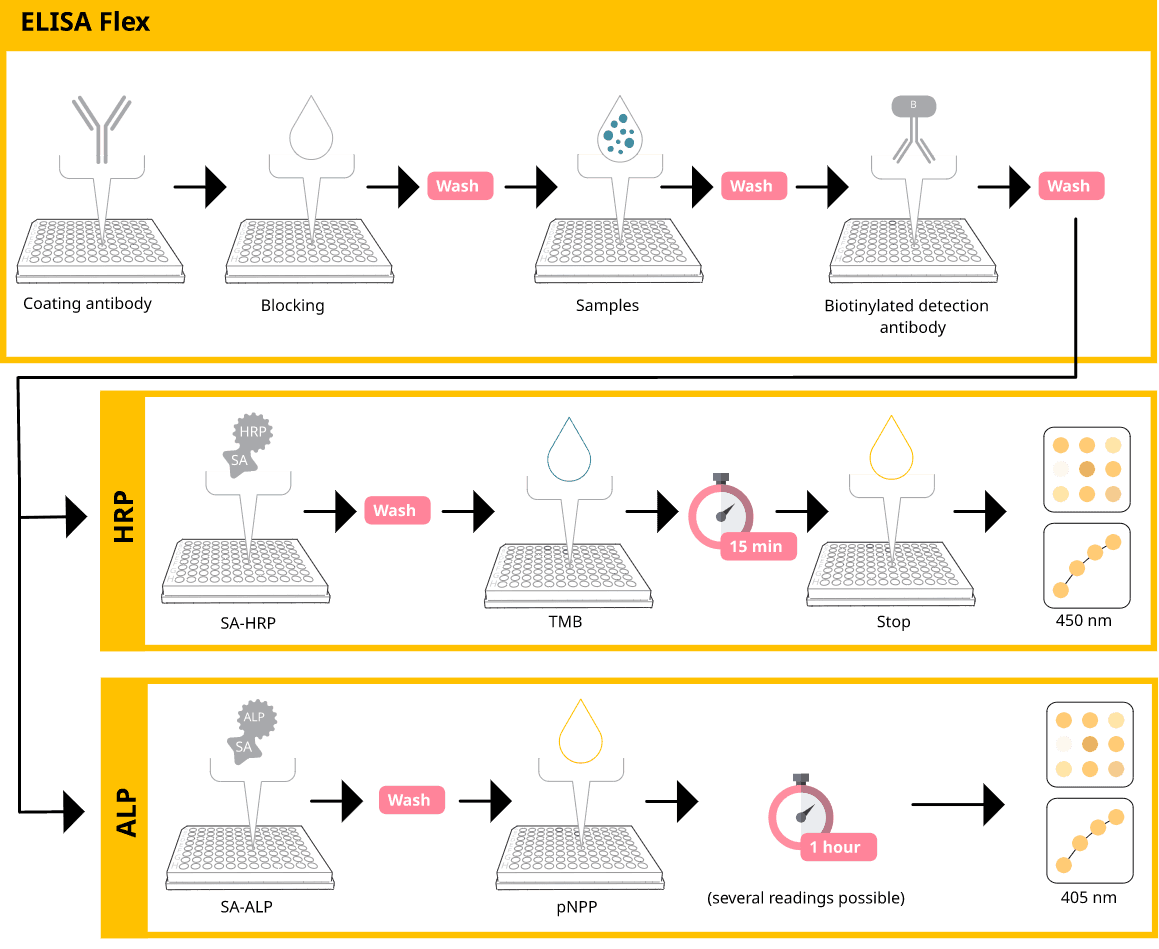
Our ELISA kits are available with either HRP or ALP as the enzyme for the colorimetric reaction.
HRP (horseradish peroxidase) and ALP (alkaline phosphatase) catalyze different reactions and require different substrates, but both generate the colorimetric signal used to quantify your analyte in ELISA. In our kits, the enzyme is supplied as a conjugate or directly linked to the detection antibody.
We generally recommend HRP due to its faster kinetics, which shortens assay time. ALP reactions are slower but offer linear activity, allowing continuous readings to identify the optimal time point. In practice, the differences are subtle – while HRP is our default choice, ALP may suit certain setups just as well.

Recommendations
| Enzyme+substrate | Development time | Wavelength | Stop solution? |
| ALP+pNPP | 60 min | 405 nm | No |
| HRP+TMB | 5 min | 450 nm | Yes |
Tip! HRP+TMB reaction is stopped and then read, whereas ALP+pNPP allows for readings at different time points.
Explore more?