
Tuberculosis diagnosis with spots
Published: November 26, 2026
8 minute read
Authored by: Jens Gertow
Tuberculosis (TB) remains a global health threat, with millions of people dying from the disease every year. Timely and accurate diagnosis is essential for effective TB control, which is why ELISpot is increasingly used. This post explores the benefits of ELISpot in TB diagnostics and points toward future antigens and biomarkers that could improve diagnosis.
Introduction
Tuberculosis (TB), caused by Mycobacterium tuberculosis, is a bacterial infection that affects the respiratory system and can spread throughout the body. Early diagnosis is essential to prevent the spread of the disease and start treatment in time.
ELISpot is an extremely sensitive immunoassay performed in a 96-well plate format to quantify cytokine-secreting cells. In TB diagnosis, PBMCs are stimulated with the antigens ESAT-6 and CFP-10. These antigens trigger TB-specific T cells to produce the cytokine IFN-γ (interferon-gamma), and after a detection antibody and a precipitating substrate are added, each resulting spot represents an individual TB-specific T cell that secretes IFN-γ. ELISpot in TB diagnosis is therefore a form of interferon-gamma release assay (IGRA). These diagnostic IGRAs can also be based on ELISA.


| Tuberculosis facts | |
|---|---|
| Caused by | Mycobacterium tuberculosis (Mtb) bacteria |
| Transmission | Airborne, primarily through coughing |
| Latent infection | Mtb can hide in granulomas, an aggregation of innate immune cells that don't do their job properly |
| Primary symptoms | Persistent cough, weight loss, fatigue, fever, night sweats |
| Advanced symptoms | Chest pain, coughing up blood, difficulty breathing |
| Prevalence | One of the top 10 causes of death worldwide |
| Incidence | Millions of new cases reported annually |
| Affected regions | Commonly found in developing countries, "a disease of the poor" |
| Diagnostics | Tuberculin skin test, sputum culture, interferon-gamma release assays (IGRA) |
| Treatment | Antibiotics for 6-9 months (adherence is essential; incomplete treatment can lead to resistant strains) |
| Vaccination | Bacille Calmette-Guérin (BCG) vaccine, with varied efficacy |
| Research | Ongoing efforts to develop new vaccines, diagnostics, and treatments |
We prefer ELISpot over ELISA
Both ELISpot and ELISA are immunological assays used to measure specific immune responses. Many healthcare providers recognize the benefits of both types of IGRA compared to the classic tuberculin skin test (TST), since TST can produce false positive results in people who received the Bacille Calmette-Guérin (BCG) vaccine. As the title of this post suggests, we prefer ELISpot-based IGRAs over ELISA-based ones. Here's why.
ELISpot-based IGRAs are more sensitive
ELISpot is more sensitive than ELISA. It can detect a lower concentration of the analyte IFN-γ, since the cytokine is captured right upon secretion, making the assay suitable for diagnosing infections at an earlier stage. ELISpot is also more sensitive because it allows for single-cell analysis: you determine the frequency of antigen-specific T cells secreting a particular cytokine, in this case IFN-γ, which gives detailed information about the immune response. The assay principle allows direct measurement of secreted cytokines, immediately upon secretion and throughout the stimulation process, giving a more specific assessment of the immune response without interference from other factors.

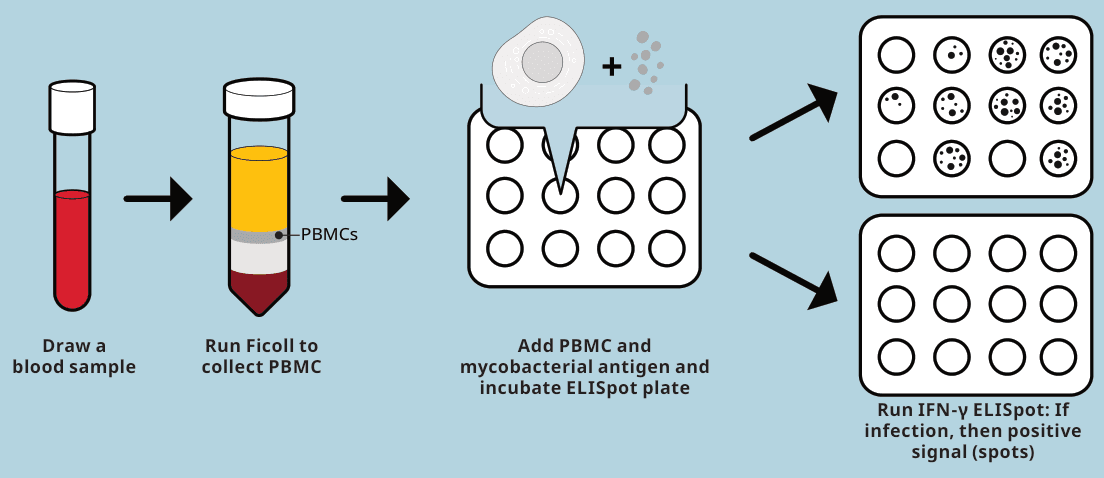
Workflow of an ELISpot-based IGRA: draw a blood sample, run Ficoll to isolate PBMCs, add PBMCs and mycobacterial antigen to an ELISpot plate, and run an IFN-γ ELISpot: an infection gives a positive signal of spots.
ELISA-based IGRAs are simpler
ELISA is a well-established and relatively simple assay that uses serum or plasma instead of living cells, as ELISpot does. It can therefore be automated fairly easily and made more cost-effective than ELISpot, which makes it practical for high-throughput screening. ELISA-based IGRAs are popular, but a slightly higher throughput isn't worth much if you risk missing positive cases. ELISpot has higher sensitivity and specificity, enabling the detection of low-frequency antigen-specific T cells. This matters particularly in TB diagnosis, where early detection is essential, and it's why ELISpot is preferred over ELISA for TB diagnostics.

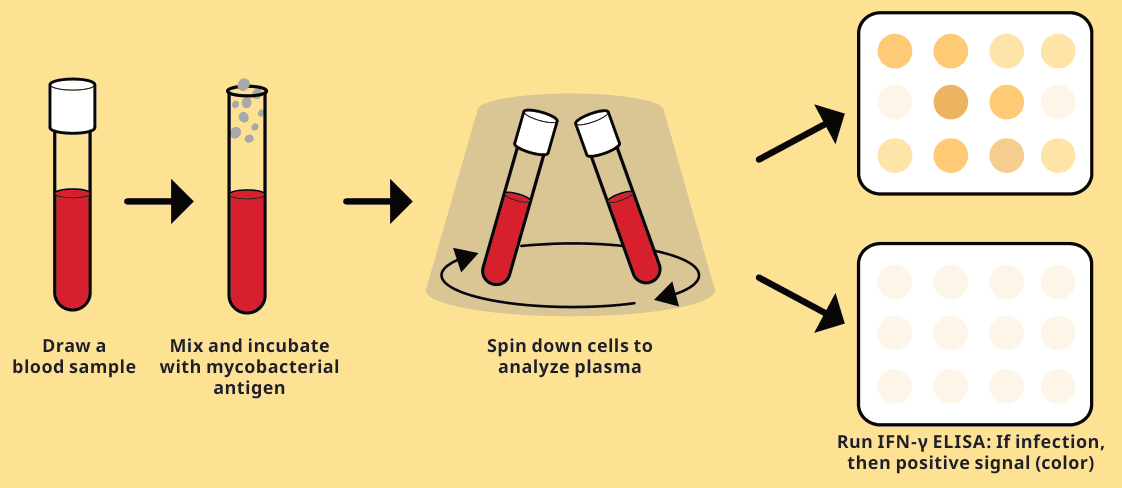
Workflow of an ELISA-based IGRA: draw a blood sample, mix and incubate with mycobacterial antigen, spin down cells to analyze plasma, and run an IFN-γ ELISA: an infection gives a positive color signal.
Up-and-coming antigens
Research continues to make TB diagnostics even more sophisticated, using additional antigens and biomarkers. ELISpot can already be adapted to test multiple TB-specific antigens, which improves diagnostic accuracy. Our ELISpot Path: TB kit (RUO) includes the antigen EspC alongside the traditional ESAT-6 and CFP-10. This third antigen could prove useful if future non-BCG vaccines start incorporating ESAT-6 and/or CFP-10, which would make today's IGRAs unable to distinguish vaccinated from infected individuals.

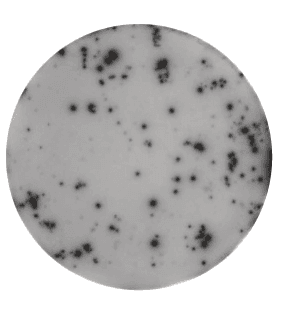
A peptide pool distinguishing active disease from latent
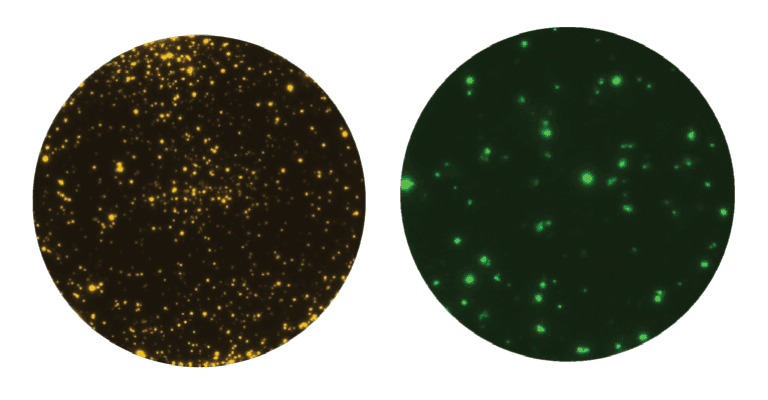
Research on multi-antigen panels holds promise for more effective TB diagnosis, including new knowledge of which T cell epitopes trigger responses in patients with active disease but not in people with latent infection. In their effort to help design new diagnostics and vaccines for TB, Cecilia Lindestam Arlehamn and her co-workers performed a proteome-wide screening of TB-derived peptides in TB patients, using an IFN-γ and IL-17A FluoroSpot assay and the Mabtech IRIS FluoroSpot reader. The comparison revealed that patients with active TB recognize different T cell epitopes than people who are healthy but latently infected. Using this information, the research group developed a peptide pool made up of epitopes recognized exclusively by patients with active TB, which lets researchers distinguish active disease from latent infection. A peptide pool like this will be important for measuring correlates of protection in vaccine development, and could be a valuable tool for new diagnostic assays. You can watch Cecilia Lindestam Arlehamn present this research in our TB webinar.



Dr. Cecilia Lindestam Arlehamn
Biomarkers other than IFN-γ
Alongside expanded antigen panels, researchers are identifying other functional biomarkers for diagnosis. IFN-γ is a good biomarker for general immune responses, but there may be more detailed information to gain from other proteins. Christopher Sundling and his team used Olink's exploratory multiplex assay and identified a 12-protein plasma signature that was highly enriched in people with pulmonary and extrapulmonary TB and also linked to disease severity. The four most interesting biomarkers among the twelve were IFN-γ, IL-6, VEGF, and IP-10, and several earlier proteomic studies supported these findings: IFN-γ levels rise during active TB, IL-6 has been linked to active and cavitary TB, and VEGF promotes blood vessel formation and can be produced by macrophages in TB granulomas. IP-10 (interferon-gamma-inducible protein 10) could be a more sensitive biomarker for diagnostics than IFN-γ, since the protein is induced downstream of IFN-γ and its signal could theoretically be amplified, although no study has shown this yet. Together, the new peptide pool and these four biomarkers are promising leads for improved TB diagnostics. A multiplex tool like FluoroSpot, or perhaps a bead-based multiplex platform, would give a richer view of disease status and severity, and could help guide treatment and strengthen TB control. We're looking forward to these developments. You can watch Christopher Sundling present these findings in our TB webinar.


Dr. Christopher Sundling
Photo credit: Carolina Sousa Silva
References
- Whitworth HS, Scott M, Connell DW, Dongés B, Lalvani A. IGRAs - the gateway to T cell based TB diagnosis. Methods. 2013;61(1):52-62. doi:10.1016/j.ymeth.2012.12.012
- Panda S, Morgan J, Cheng C, et al. Identification of differentially recognized T cell epitopes in the spectrum of Mtb infection. Preprint. bioRxiv. 2023;2023.04.12.536550. Published 2023 Apr 13. doi:10.1101/2023.04.12.536550
- Mousavian Z, Folkesson E, Fröberg G, et al. A protein signature associated with active tuberculosis identified by plasma profiling and network-based analysis. iScience. 2022;25(12):105652. Published 2022 Nov 22. doi:10.1016/j.isci.2022.105652