Anti-human/monkey TNF-α mAb (MT15B15), PF647P

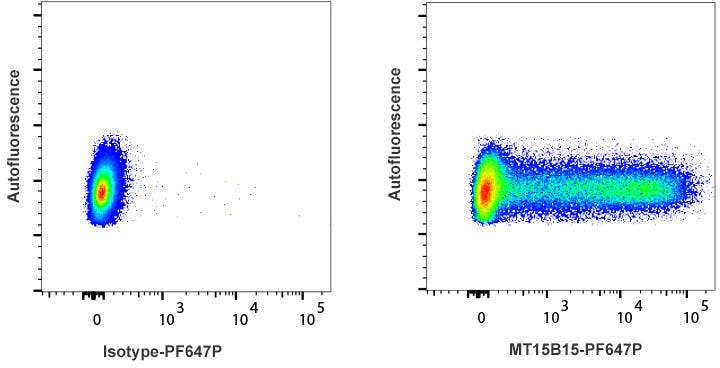
Anti-human/monkey TNF-α mAb (MT15B15), PF647P
Intended use
This monoclonal antibody enables specific detection of monkey TNF-α-producing cells in flow cytometry.
Serum/Plasma samples
Recommendation
5 µl is recommended for staining of 1 million cells in a total volume of 50 µl. PF647P is excited by the red laser (633 nm). The excitation max is 654 nm and the emission max is 672 nm.
Product details
| Product | Anti-human/monkey TNF-α mAb (MT15B15), PF647P |
| Application | Flow cytometry |
| Analyte | TNF-α |
| Antibody | MT15B15 |
| Conjugate | PF647P |
| Clonality | Monoclonal |
| Immunogen | Recombinant human TNF-α |
| Host | Mouse |
| Isotype | IgG1 |
| Reactivity | Non-human primates |
| Specificity | Native TNF-α from rhesus and cynomolgus macaques. Native and recombinant human TNF-α. |
| Cross-reactivity | For information on reactivity with other non-human primates (NHP), please check the NHP cross-reactivity guide. |
| Supplied in | PBS with 0.2% BSA and 0.09% sodium azide. Sterile-filtered (0.2 µm). |
| Contents | Monoclonal antibody MT15B15, conjugated to PF647P fluorophore. Ready to use. |
Shipping and Storage
| Shipping | Shipped at ambient temperature. |
| Storage | Store product at 4-8 °C. |
| Shelf life | At least 12 months from date of receipt. |