
Your immune assay is missing the cells that matter most
Published: April 15, 2026
5 minute read
Authored by: Jens Gertow
Most labs measuring immune responses reach for ELISA. It's familiar, scalable, and easy to run. But it has a blind spot – and that blind spot is exactly where the most important biology often happens. This guide explains what that blind spot is, and introduces two assays built specifically to see past it: ELISpot and FluoroSpot.
What standard assays miss
When the immune system responds to a pathogen or a vaccine, the relevant cells – T cells and B cells – do so by secreting proteins: cytokines like IFN-γ, or antibodies. But there is a potential problem: the cells doing that secretion can be extraordinarily rare. You might be looking for one reactive cell among a million.
ELISA measures the total amount of a protein across your entire sample. If a thousand cells are all secreting at once, ELISA will pick that up. But a handful of rare, antigen-specific cells? Their signal is drowned out completely. You get a number, but you miss the response.
ELISpot and FluoroSpot solve this by detecting secretion at the single-cell level. Instead of asking "how much IFN-γ is in this tube?", they ask: "how many individual cells are actually secreting it?"

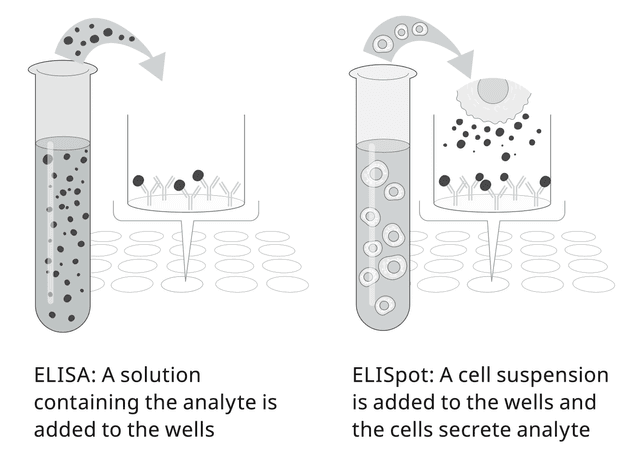
How ELISpot works – the short version
Cells are placed in a specialized well coated with capture antibodies. When a cell secretes a target protein – say, IFN-γ – the protein is immediately captured by the coating right where it was released. After the cells are washed away, a detection step makes each secretion event visible as a small colored spot on the membrane.
Each spot = one cell that responded. Count the spots, and you know both how many cells reacted and – from the size and intensity (the “volume”) of each spot – something about how vigorously each one did so.
FluoroSpot works the same way, but uses fluorescent labels instead of an enzyme-color reaction. This means you can detect multiple analytes simultaneously in the same well because each target gets its own fluorescent color.

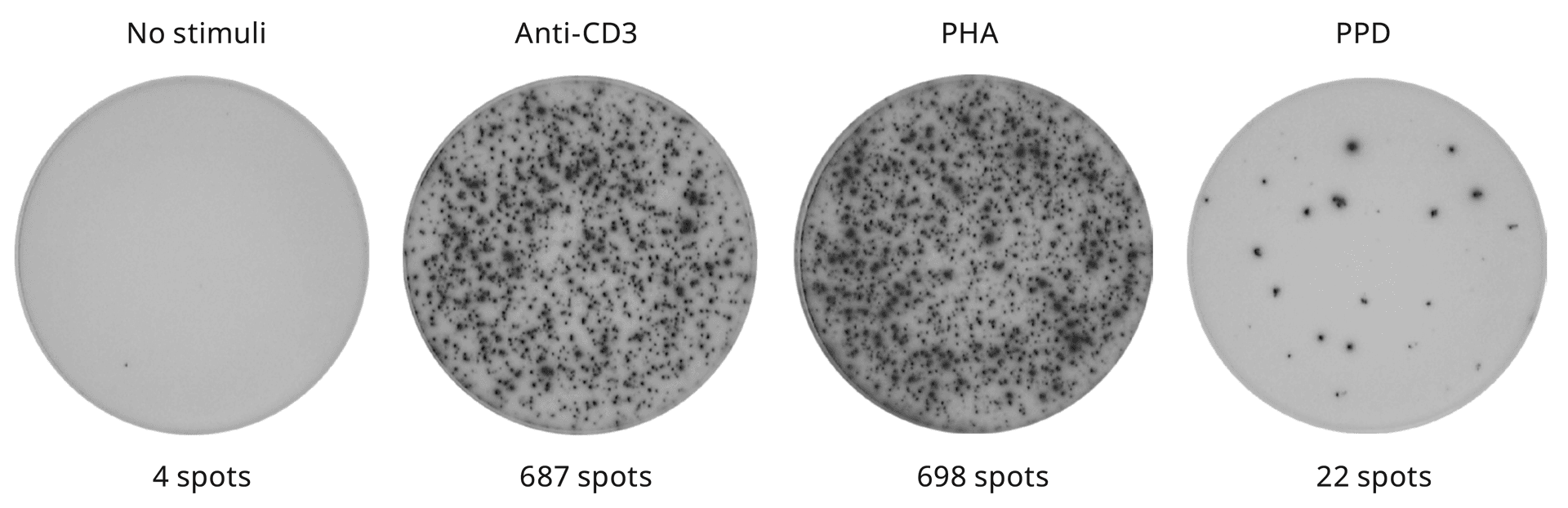
Human IFN-γ ELISpot
IFN-γ secretion by peripheral blood mononuclear cells (PBMCs) incubated overnight without stimuli or with anti-CD3, phytohaemagglutinin (PHA) , or purified protein derivative (PPD).
Why not just use ELISA or flow cytometry?
Both are excellent tools, but for different things.
ELISA measures bulk, not cells
ELISA tells you the total concentration of a protein in a sample. That's useful for many applications, but it can't tell you how many cells produced it, and it will miss a response from rare cells entirely. ELISpot is roughly 100–200 times more sensitive than ELISA when it comes to detecting cytokine-secreting cells – because you're looking at each cell individually, not averaging over millions.
Flow cytometry is powerful – but demanding
Flow cytometry can also detect individual cells and even multiple cytokines at once, with the added benefit of phenotyping (identifying what type of cell you're looking at). But it requires more expertise, more validation, and considerably more cells per test. ELISpot, on average, needs one-tenth the number of cells – which matters enormously when samples are small or precious. It's also easier to standardize and analyze: spot counting is far less complex than multi-parameter flow data.
In short: if your question is "how many antigen-specific T cells are responding?", ELISpot and FluoroSpot give you a clear, sensitive answer with a simpler workflow than flow cytometry and far greater sensitivity than ELISA.

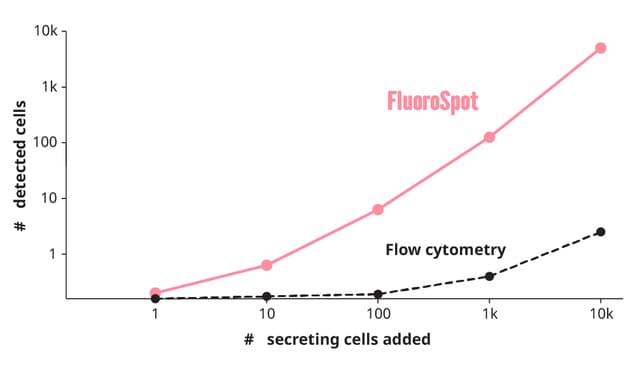
Less cells are needed for a detectable response in FluoroSpot.
What are ELISpot and FluoroSpot actually used for?
These assays have become cornerstones of immune monitoring across a wide range of fields. Common applications include:
- Vaccine development and immunogenicity testing: measuring whether a vaccine is generating a T cell response, and how strong it is.
- Infectious disease research: including HIV, tuberculosis, COVID-19, hepatitis, and EBV. ELISpot has been central to TB vaccine trials, where IFN-γ secretion is a key biomarker.
- Cancer immunotherapy: monitoring T cell responses to tumor antigens, which is critical when evaluating checkpoint inhibitors or cell therapies.
- Allergy research: detecting allergen-specific responses from immune cells.
- Clinical trials: ELISpot is the most widely used method for cellular immunogenicity assessment in regulatory submissions.
ELISpot or FluoroSpot – how to choose
Both formats share the same core technology and sensitivity. The choice comes down to what question you're asking.
Choose ELISpot when:
- You need to measure a single analyte, for instance, IFN-γ or IL-2, and want a straightforward, well-validated readout.
- You want maximum simplicity: ELISpot uses a chromogenic (colored) reaction that's easy to read and doesn't require a fluorescence reader.
- You're working in a setting where the protocol needs to be as streamlined as possible – ELISpot is the format regulators and clinical labs know best.
Choose FluoroSpot when:
- You want to measure two, three, or even four analytes simultaneously in the same well. This is FluoroSpot's defining advantage.
- You're interested in polyfunctional T cells, i.e., cells that secrete more than one cytokine at the same time. Cells producing both IFN-γ and IL-2, for example, are associated with stronger protective immunity. FluoroSpot is the only single-well method that can identify them.
- Your samples are limited: measuring multiple analytes from the same well means you need fewer cells overall.
- You want richer data: not just "how many cells responded" but "how many responded with this combination of cytokines" – a much more nuanced picture of immune function.

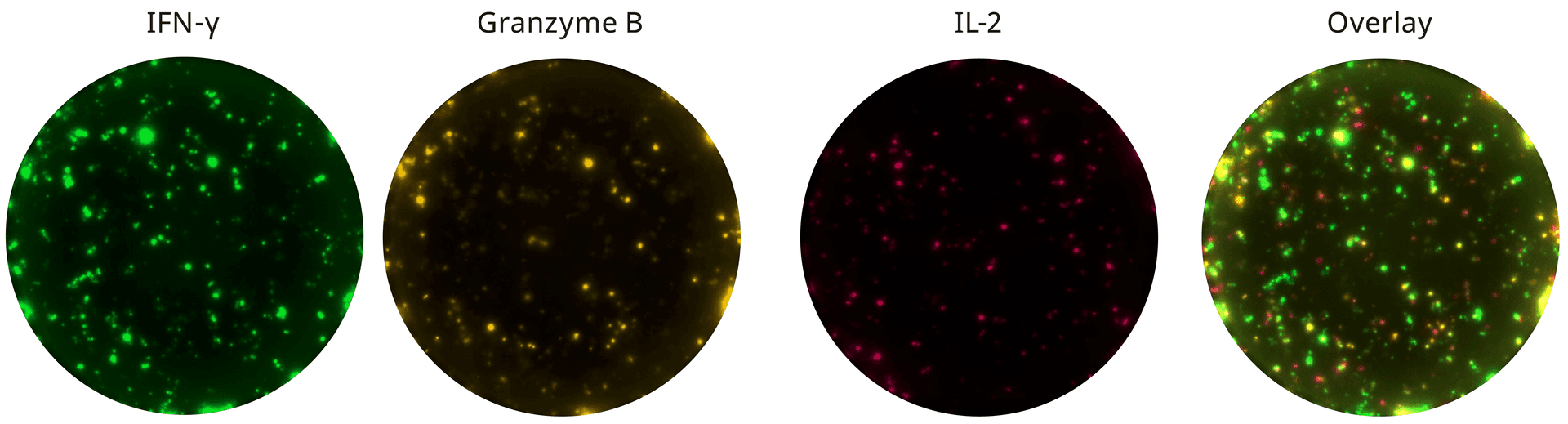
FluoroSpot analysis showing three individual images from the same well and an image overlay, combining images from the three filters.
Where to go from here
If you're new to this space and need to measure a single cytokine response – start with ELISpot. It's simple, robust, and the most established format in the field. If your questions are more complex – multiple cytokines, polyfunctionality, limited sample volume – FluoroSpot is the natural next step.
Mabtech has developed both ELISpot and FluoroSpot since the technology was first introduced. You can explore our ELISpot kits and FluoroSpot kits on our website.
Still not sure which format fits your experiment? Reach out, we're happy to help you figure it out.